
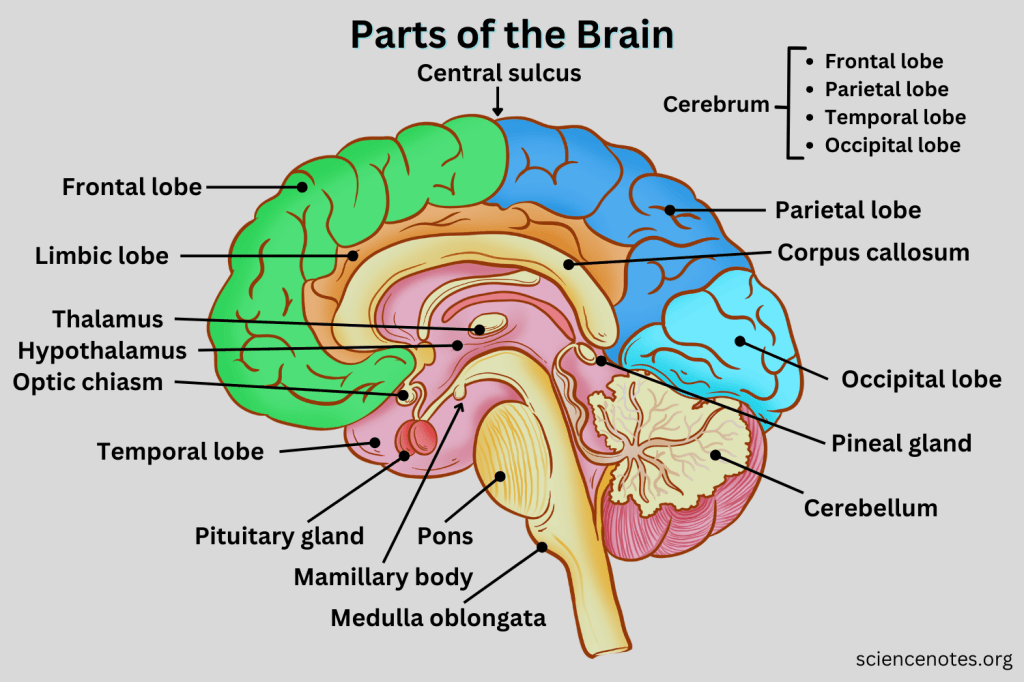
A simple way to frame what happens in the brain? Not easy, but here it goes, the connections! The frontal lobe is responsible for executive functions, such as planning what you want to write or paint and using the chosen materials. It is also responsible for how much attention we give to our actions and how we enhance them. The frontal lobe is where we sort out our emotional self.
Next, the temporal lobe is where the hippocampus is. The hippocampus is where memories are made.
The parietal lobe is home to the somatosensory cortex. Information about body sensations, such as touch and pain, is found and applied through the somatosensory cortex.
The somatosensory cortex receives and interprets these sensations—the occipital lobe processes visual information.
Directly under the occipital lobe, imagine a roundish oval part of the brain called the cerebellum. The cerebellum controls balance, movement, coordination, and habit-forming information. This also means the cerebellum is responsible for a form of procedural memory.
Procedural memory allows the body to repeat movements without having to relearn them. This is true of walking, running, dancing, and anything that is repeated.
Shibui Found Image Art is a problem-solving art that requires focus. The bottom line is that the different parts of the brain do not work alone! They work by cooperating! We could not function otherwise!
Within the lobes of the brain are several structures that together make up the limbic system. The limbic system is also known as the ancient brain. It is a network where emotion and behavior are found. This is where the fight-or-flight response stems from. The limbic system also helps to keep the body in homeostasis, which is how we remain in a state of proper balance. The limbic system includes the hypothalamus, which governs the heart rate, body temperature, and blood pressure. The body gets a bit wonky whenever these are not in a normal range. We may develop diseases.
The thalamus transmits all sensory information throughout the brain, except smell. Its shape is oval, and it is called the amygdala. It detects things that threaten us instantly. It perceives from what it knows through experience.
The brain is connected through the brain stem, which communicates with the spinal cord. The autonomic nervous system comprises structures within the brain and spinal cord. It’s split into two parts called the sympathetic and parasympathetic nervous systems. They are separate systems that work in union with one another. Think of them this way: The sympathetic nervous system preps you for action, while the parasympathetic nervous system prepares you to rest and reset, for example, how we process food.
Unless you think of how your body responds to the aesthetic stimuli of the world around you, there may seem to be little reason to think of how the mind and body work together. However, how the mind and body respond to what triggers within its creative process matters in art therapy.
It is essential for the person with the injured brain, someone with anxiety, emotional disorders, ADHD, Bipolar, Autism___ the list of people who are helped by therapy grows as we learn what else works. I think of sound therapy, music, writing, art or crafts_____. It is the mind at work, the body responds to solve through the senses, through visual information or touch____ smell what the experience is about. The injured mind can relearn through rewiring itself. If we understand how a normal brain works, we can help it work its healing processes.
Shibui Found Image Art begins with action art, and then becomes found image art. It is physical and requires choices “to-be-made” regarding the materials one uses. It requires thinking about possible movements and what they may do. The focus is on what might and is likely to happen if I do a particular physical movement. The Shibuiest learns about possibilities, randomness; they learn to let go of traditionally planned structures because there is no preconceived understructure. What is needed is a type of re-engineering process where you imagine what the understructure would be like. Only then can you put in place the enhancement of shapes through shading and defining what is intentionally designed.
The “shapes that become form” within the framework of a Shibui foundation are triggered by the mind’s interpretation of them. The imagination allows us to finish what we find intentionally.
The process of creating a Shibui Found Image Art is held in memory, and then we perceive and predict what is possible.
Best wishes! Pejj Nunes
 Anisette Studio
You must be logged in to post a comment.